Why the Gate Is Almost Always the First Thing to Go Wrong
A fence can stand for years while its gate quietly gives up first. The reasons are mechanical, not mysterious.
September 8, 2026 · 3 min read
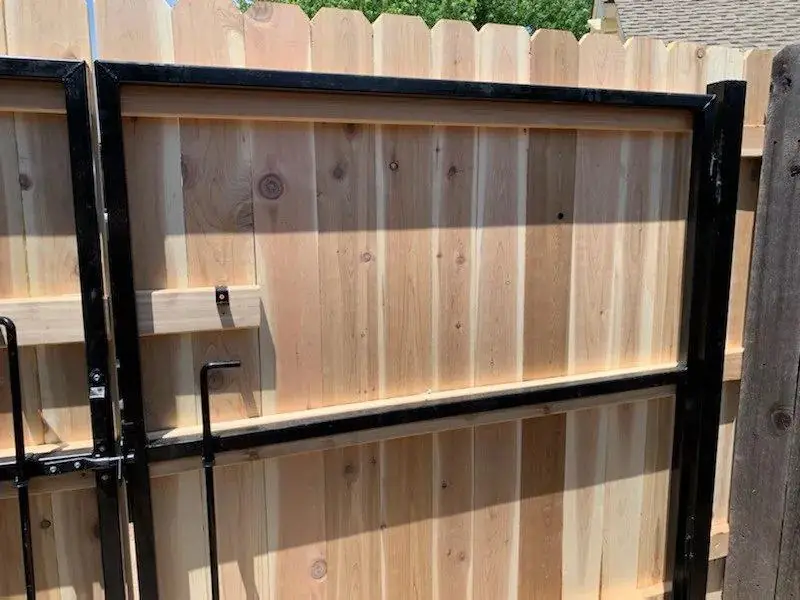
If a fence is going to have a problem, it usually shows up at the gate before it shows up anywhere else. Not because the gate is built from different material, but because it is the one part of the fence that actually moves, every single day, under its own weight, on hinges that are doing constant work the rest of the fence never has to do.
"A gate that drags is the first thing anyone notices" is something we say a lot, because it is true in a very literal sense. Nobody walks the length of a fence line checking for plumb posts. Everybody notices a gate that scrapes the ground or has to be lifted to close.
The physics of why it happens
A section of standing fence is supported along its whole bottom edge, tied into posts on both sides, sharing its weight across a run. A gate is a cantilever. It is anchored on one side only, at the hinge post, and every bit of its weight is trying to pull that post out of true every time the gate swings. Over time, if the post was not set deep enough or the frame was not built to resist twisting, that pull wins, and the far corner of the gate drops.
What actually stops it
We frame gates not to sag as a specific, deliberate step, not an afterthought after the fence is up. That means a frame built to resist racking under its own weight, hung on heavy hardware sized for the gate rather than whatever hinge happened to be on hand, and posts set with the extra pull of a swinging gate accounted for, not just treated the same as a standing fence post.
- The hinge post gets more attention during setting than a standard line post, because it is carrying more load
- Hardware is sized to the actual weight of the gate, not a generic hinge
- The frame itself is built to resist twisting, not just to hold pickets
- Every gate is tuned on site and adjusted until it closes clean before the crew leaves
Double gates fail for a different reason
A single gate has one hinge post to worry about. A double gate, the kind used for a driveway or wide equipment access, has two, and those two posts also have to line up with each other well enough that the gates meet cleanly in the middle. If either hinge post settles even slightly out of alignment with the other, the gates stop meeting flush, and most people read that as a broken latch when it is really a foundation issue on one side. That is part of why a wide opening deserves more attention at the post-setting stage than a narrow single-gate walkway, not less.
What we build when someone wants more than a standard gate
Custom gate work is a regular part of what we do, including a cut-in dog window: a section with a solid cedar frame and smooth edges that gives a dog a clean sightline to watch the street without testing the fence line by jumping or pushing at it. It is a small detail, but it points at the same underlying principle as sag prevention. A gate has to be built for how it is actually going to be used, not just built to match the fence next to it.
If you already have a gate that is starting to drag
A few things are worth checking before assuming the whole gate needs to be replaced. Loose hinge screws are the most common and the easiest fix, and it is worth checking those first. After that, look at whether the hinge post itself has started to lean, which usually points to a post that was not set deep enough originally. A diagonal brace can sometimes correct a mildly racked frame, but if the post has genuinely shifted in the ground, that is a foundation problem, not a hardware problem, and tightening hinges will not solve it for long.
The workmanship on every fence and gate we build is backed by a warranty put in writing, because a gate that starts sagging in the first year or two is almost always a build problem, not a wear problem. A gate is supposed to work the same way five years in as it did the day the crew left. If it does not, that is worth a phone call, not a shrug.
Fence Masters — (405) 728-3200
Call (405) 728-3200More articles
Will a Cedar Fence Actually Hold Up in Oklahoma Wind?
The wood gets the credit, but the wind test is really won or lost underground.
Built From Scratch vs. Box Store Panels: What the Difference Actually Costs You
The difference is not really about looks. It shows up years later, at the posts and the gate.