Built From Scratch vs. Box Store Panels: What the Difference Actually Costs You
The difference is not really about looks. It shows up years later, at the posts and the gate.
September 8, 2026 · 4 min read
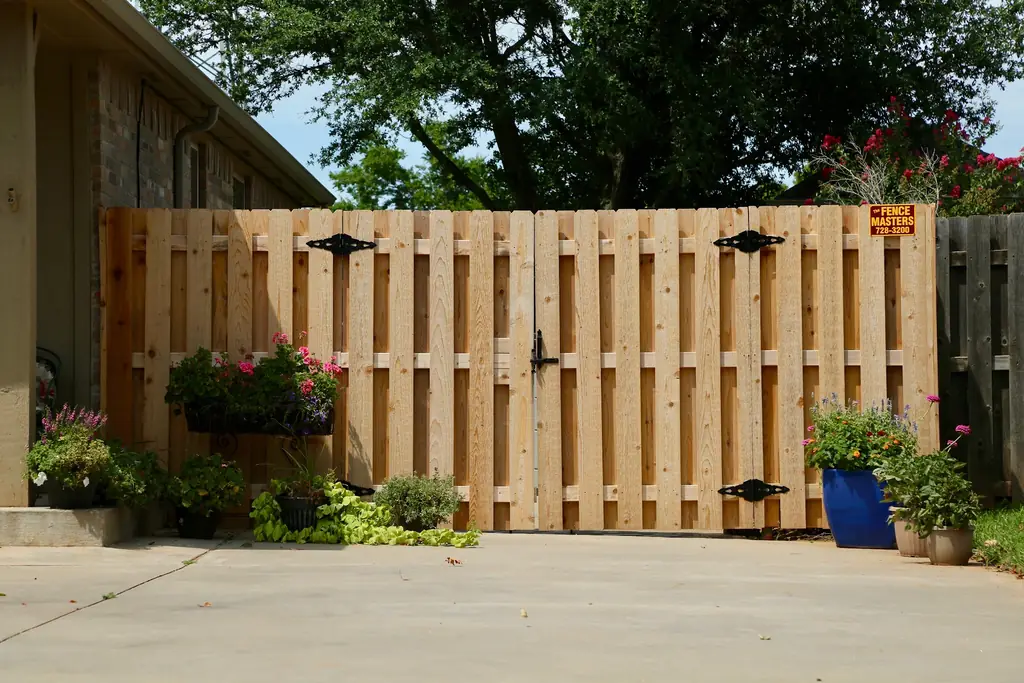
Most people shopping for a fence assume the question is cedar versus iron, or 6 foot versus 8 foot. The bigger question, and the one that shapes how the fence behaves for the next fifteen years, is whether it was assembled from pre-built panels or cut and set from scratch on your actual property. We build every fence the second way, and it is worth explaining what that changes in practice, not just in principle.
A panel is built for an average yard. Your yard is not average.
Pre-built fence panels are manufactured to a fixed width so they can be shipped and stacked and sold off a shelf. That means the post spacing on the finished fence gets decided by the panel size, not by the terrain, the slope, or where a gate actually needs to land. If your yard has a grade change, a tree root, a utility line, or a property corner that is not a clean right angle, a panel system has to compromise around all of it, because the panel itself cannot flex.
Building from scratch flips that order. We walk the property first, look at the grade, the corners, and where the gates need to fall, and then set post spacing and picket runs to fit what is actually there. The fence gets built for your yard instead of your yard getting fitted around the fence.
It shows up first at the ground
Slope is the clearest example. A panel system on sloped ground usually steps down in fixed increments, leaving visible gaps under each panel that get bigger as the grade changes. A scratch-built fence can rack, meaning each picket is trimmed individually to follow the slope, so the bottom line stays consistent instead of stair-stepping. It is more work to build. It also does not leave a gap for a dog, a lawnmower thrown rock, or standing water to find.
It shows up years later at the gate
Gates take more abuse than any other part of a fence, because they move and get used every day. A gate built to match a pre-sized panel opening often has less room to frame in real bracing, because the frame has to fit the gap the panels left rather than the gap being built around the frame. That is a big part of why gates on panel systems are the first thing to sag.
Our gates are framed not to sag from the start, hung on heavy hardware, and tuned on site until they close clean before we leave. That is only possible because the opening was built for the gate, not the other way around.
Material grade is part of it, but not the whole story
We build with kiln dried Western Canadian Red Cedar at 7/8 inch thickness, 1x4 pickets with cap and trim, over steel posts set deep in quality concrete. That is a real material difference from a lot of what ships as a panel. But even the same grade of cedar behaves differently depending on whether it was assembled at a factory to a fixed width or cut and fitted on your actual property. Fit is what determines whether the wood is doing its job or fighting a gap it was never meant to cover.
What to ask, if you are comparing quotes
- Is the fence built from pre-sized panels, or cut and set on my property
- How does the system handle a slope or grade change without leaving gaps
- Is the gate frame built to fit the opening, or is the opening sized to a standard gate
- What is the post spacing based on: the terrain, or the panel width
The corner problem panels can't really solve
Property corners are rarely a clean 90 degrees once you actually measure them, and a run of fixed-width panels has no way to adjust for that without leaving an odd short panel or an awkward gap at the end of the line. Building from scratch means the last picket run before a corner or a gate gets cut to fit that exact distance, so the fence reads as one continuous line instead of ending in a visibly mismatched section. It is a small detail from the street, but it is usually the first thing that gives away a fence assembled from stock parts.
None of this means every panel fence is bad, or that a scratch-built fence is automatically flawless. It means the two are not really the same product wearing different price tags. One is built for an average lot. The other is built for the lot you actually own. Every fence we have built across the Oklahoma City metro since 1998 has been the second kind, left stain ready so you can finish it your way once it is up.
Fence Masters — (405) 728-3200
Call (405) 728-3200